Eliza's Sword
The Reincarnated Demon King's Host Just Wants to Live in Peace, But the Hero Won't Leave Him AloneEliza's Sword is the weapon carried by Luc in his role as the Hero, though its history belongs first to Hero Eliza. More than an ornamented blade, it is the object through which the narrative makes heroic power physically legible: it has nearly killed Malthios, can pierce a demon body with terrifying ease, and stands at the center of the conflict between inherited duty and a self-chosen life.
Appearance and First Recognition
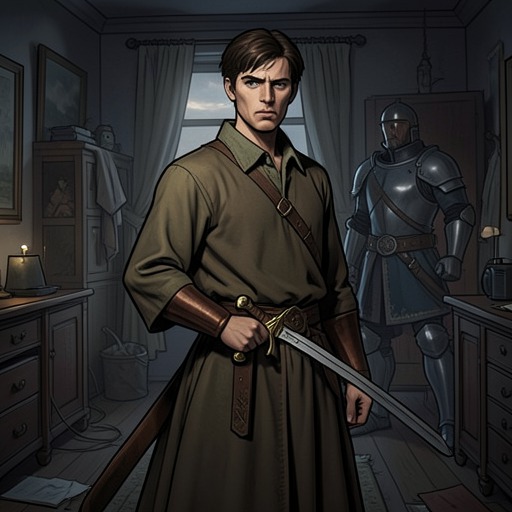
When the Hero's party arrives at the healer's cottage, Luc is identified by his broad, well-trained body, his gold-edged navy coat, and the light leather armor protecting his vital organs. Eliza's Sword hangs at his side. To Theo, it initially appears to be an exceptionally well-made blade decorated with several gems, but Theo's perception is inseparable from Malthios's presence within him. The Demon King trembles at the sight, weakening Theo's knees before Luc has even properly addressed him.
Malthios immediately recognizes the weapon as Eliza's. The recognition is not intellectual alone: the sword is the blade that almost killed him. Its material details therefore conceal a history of defeat that ordinary observers cannot see. For Theo, the sword becomes frightening precisely because it looks almost ordinary while carrying a memory of mortal danger for the soul inside him.
Luc's Combat and the Heroic Weapon
The sword's significance expands when Theo watches Luc train. The power of the Hero is described as physical rather than primarily spell-based, granting resilience, speed, strength, accelerated healing, and resistance to magic. Those capacities are cultivated through training: Eliza began at twelve, whereas Luc began at five. The weapon is thus not an isolated source of victory but the instrument of a body disciplined from childhood for combat.
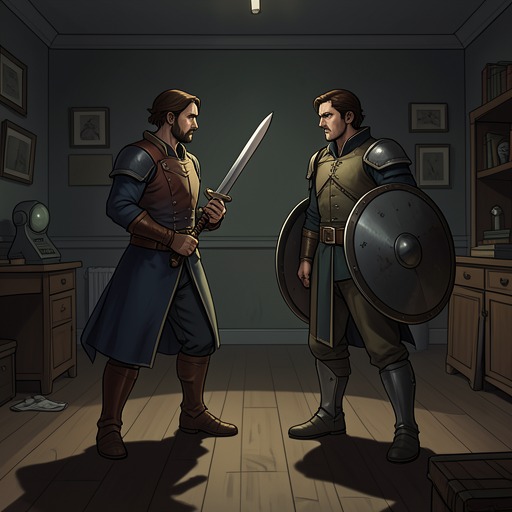
During the duel, the blade has a strange red sheen, resembling blood soaked into the metal. That appearance flashes into Theo's mind alongside the memory of the sword plunging into his stomach, causing him to flinch before the fight begins. Luc then moves with extraordinary fluency, his body flowing from one motion to the next while the sword functions as an extension of his arm. His speed and fearlessness lead Malthios to judge him superior to Eliza and to call him a true Hero capable of defeating even deities.
The scene gives the sword two simultaneous meanings. To Luc, it is a practiced extension of heroic mastery; to Malthios, it is the return of an old wound. The contrast makes the weapon a bridge between generations of Heroes while also marking a difference between Eliza's legacy and Luc's individual style.
Violence and the Turning of the Conflict
The sword's most devastating appearance comes when the Hero attacks Aym and the members of the Pentagram. A figure appears beside Aym and drives the blade through their body. Malthios recognizes the body intimately and watches the sword tear through it, yet is initially unable to produce a sound. The weapon's violence is therefore not abstract battlefield spectacle: it destroys someone bound to Malthios by physical intimacy and personal attachment.
Luc's attack continues against Torq, Foras, and Malthios. Torq summons roots and rocks, while Foras sends a rain of ice shards, but the Hero dodges every attack and cuts through the magical defenses. When Torq throws himself in front of Foras, the sword remains the decisive force. Malthios counters with a sword stroke followed by blue fire, but Luc blocks it and closes the distance. Malthios manages to defend himself while surrounding the area with fire, yet Luc's unmatched speed and strength allow the next blow to catch him in the shoulder and throw him backward.
In this sequence, Eliza's Sword is not merely an heirloom or badge. It is the practical mechanism of the Hero's institutional mission to destroy demons, and its effectiveness makes that mission personally catastrophic for Malthios. The blade links the earlier near-death of the Demon King to the later assault on his companions, turning history into recurring bodily threat.
Bloodline, Inheritance, and Choice
The sword also belongs to the political structure surrounding the Hero. Julius explains that Eliza pressured him to leave Luc because she wanted Luc to continue the Heroic bloodline and sire the next Hero. The demand places Luc's body, relationships, and future under the same hereditary logic represented by the weapon at his side. Eliza's Sword consequently signifies not only combat inheritance but the expectation that Luc must reproduce the heroic institution through his own family.
Luc's relationship with Theo contests that expectation. Luc describes a history of relationships interrupted by the Hero's itinerant life, including a maid in training, a squire who trained with him, and later partners encountered during stays in towns. The sword's presence beside him contrasts with the instability imposed by his title: it gives him a heroic identity while making ordinary lasting attachment difficult. His bond with Theo begins to redirect the meaning of that identity away from bloodline and toward chosen companionship.
That redirection is made tangible through another object. Luc gives Theo his father's ring, a silver band textured like scales with a dark sapphire set into it, and places it on Theo's marriage finger. The ring comes from a father who died saving an adventuring party from a demon attack, whereas Eliza's Sword embodies the weaponized continuity of the Hero's office. Together, the objects stage two competing inheritances: one transmitted through heroic violence and expected descendants, the other transformed into a personal promise between partners.
Final Significance
At court, Eliza treats Luc's refusal as the abandonment of everything he has trained his whole life to accomplish and as the end of their bloodline. Luc answers that choosing a quiet and peaceful life with the man he loves is the only choice he has ever made for himself, and he argues that those born with the Hero's gift should be able to choose their fate rather than remain bound to duty. Eliza's Sword is not explicitly discarded, but its authority is challenged at the level that matters most: Luc refuses to let the weapon's inherited meaning determine his future.
The blade therefore persists as a symbol with changing force. It begins as Eliza's nearly lethal weapon, becomes the object that exposes Malthios's buried terror, serves Luc as the instrument of breathtaking combat, and finally stands behind a heroic system Luc seeks to reform. Its history is built on blood, but the narrative's resolution places that history beside the sapphire ring and the promise of shared life. Eliza's Sword remains the emblem of what Luc was trained to be; Luc's choice determines what that inheritance will mean afterward.